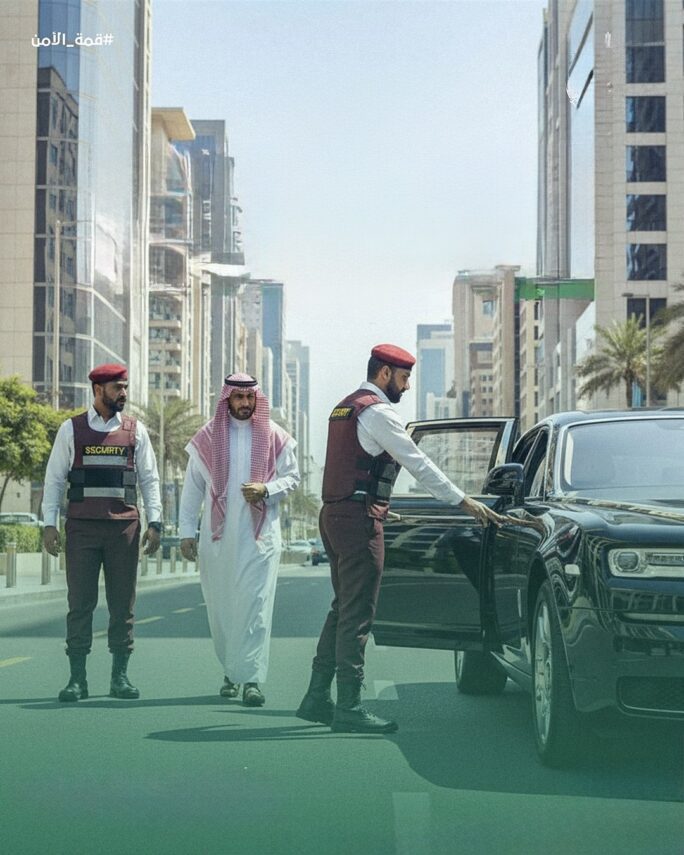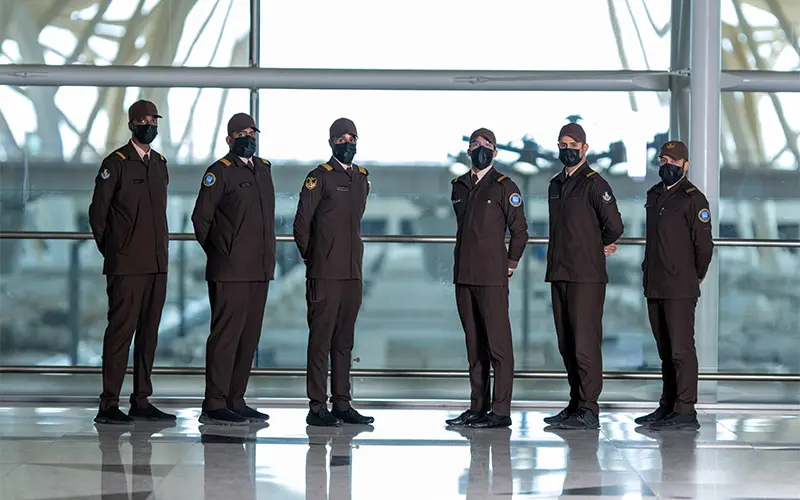
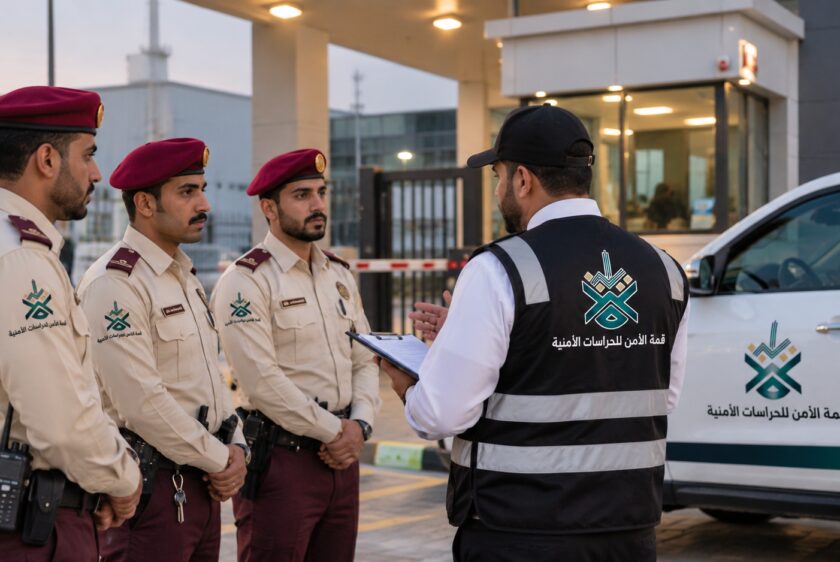
In Saudi Arabia, a security guard is a licensed civilian employed by a guarding company under the Private Civil Security Guarding Law to protect one contracted site. The police are a government force within Public Security at the Ministry of Interior, with powers to arrest and investigate anywhere. Guards prevent, observe and report, while police take legal action.
Key Takeaways
- A security guard in Saudi Arabia draws his role from the Private Civil Security Guarding Law of 1426H and the guarding contract.
- Police officers are criminal investigation officers under the Law of Criminal Procedure, and only they can arrest and investigate.
- A guard calls 911 in the Riyadh, Makkah, Madinah and Eastern Province regions, and 999 for police and 998 for Civil Defense in the other regions.
- A security guard wears the uniform of his employing company under Article 8 of the law, and it must never suggest he is police.
- At an incident, a security guard protects people, reports at once, protects the scene and hands information to the police.
What is the difference between a security guard and the police in Saudi Arabia?
The core difference is the source of authority: a guard acts for the site owner and within the site, while the police act for the state and everywhere. Article 1 of the law defines a security guard as the person assigned to guard facilities to keep their staff, funds and property safe from theft and assault.
Security guard
- Legal basis: the Private Civil Security Guarding Law, its Executive Regulations and the guarding contract.
- Reports to: the licensed guarding company, under the oversight of the security authorities and HCIS.
- Where authority applies: the contracted site only, its gates, buildings and car parks.
- Core powers: prevention, observation, access control and reporting.
- Uniform and identification: the company uniform, a company ID card and a security guard licence.
- Accountability: to the company and the client, and the company faces penalties under the law for violations.
Police
- Legal basis: the Law of Criminal Procedure and the security laws of the state.
- Reports to: Public Security at the Ministry of Interior, through the regional or governorate police.
- Where authority applies: every public and private place within its jurisdiction.
- Core powers: law enforcement, arrest, initial investigation and public order.
- Uniform and identification: the official uniform, a military rank, an official ID and a marked security vehicle.
- Accountability: to the state through its laws and government oversight bodies.
What legal basis does each role have in Saudi Arabia?
Guarding work rests on the Private Civil Security Guarding Law, issued by Royal Decree M/24 dated 8/7/1426H, and its Executive Regulations of 1427H, while police work rests on the Law of Criminal Procedure issued in 1435H.
What the guarding law sets for the guard
- Guards must be Saudi nationals, and the licensed company must train and qualify its guards.
- The security authorities may inspect guarding companies and guards to confirm compliance.
- HCIS issues guarding licences and inspects companies, and began taking applications online in September 2025.
What the Law of Criminal Procedure sets for the police
The Law of Criminal Procedure defines criminal investigation officers as those who search for offenders and gather evidence, and lists police directors and their assistants among them. Security guards are not on this list, so a guard holds no power to arrest or investigate, whatever his training.
What powers does a guard have and what stays with the police alone?
Guard powers are tied to the site, while criminal investigation belongs to the police alone. A guard manages entry, asks for ID at the gate and records what he sees, then hands anything beyond that to the police.
- Only the police can make a formal arrest, hold a person for questioning and refer the case to the Public Prosecution.
- Only the police can collect criminal evidence, question suspects and take formal witness statements.
- Only the police can control public places and roads and disperse crowds outside the property.
Detention, searches and force are covered in our two related legal articles.
How can you tell a security guard from a police officer on site?
The easiest way is the uniform: a guard wears the company uniform with its logo, a police officer wears the official Public Security uniform with his rank, and Article 8 binds guards to the uniform of their employer.
- A guard carries an ID card with his name and the company name, and he holds a guard licence renewed yearly under the fee schedule approved in 1444H.
- A guard does not use titles, badges or phrases that suggest he is a police officer, such as ordering someone to stop in the name of the state.
Female security guards at women only sites are civilians too.
When does a guard call 911, 999 or 998?
The number depends on the region: 911 is the unified number in four regions, and elsewhere a guard calls the police on 999 and Civil Defense on 998, according to Public Security and Civil Defense statements.
In Riyadh, Makkah, Madinah and the Eastern Province
- Police: 911.
- Civil Defense for fire and rescue: 911.
- Ambulance through the Saudi Red Crescent Authority: 997.
In the other regions such as Qassim, Tabuk, Asir, Jazan and Hail
- Police: 999.
- Civil Defense for fire and rescue: 998.
- Ambulance through the Saudi Red Crescent Authority: 997.
A guard calls the police for theft, assault or a fight, and Civil Defense for fire or a gas leak, then informs his supervisor and the client representative.
How does a security guard hand an incident over to the police?
A proper handover means the police arrive at a safe, protected scene with organised information, because the task of the guard ends where the official process begins.
- Make people safe first: move visitors away from danger and call an ambulance if anyone is hurt.
- Report on the correct number for the region, giving the address, the nearest gate and the type of incident.
- Protect the scene: stop anyone touching items, cleaning the area or moving vehicles.
- Log the facts with times, witness names, the report number and the receiving officer name.
- Make client camera recordings available under site management instructions.
Once police arrive, the guard is a witness and does not interfere.
What cooperation duties link guarding companies and the security authorities?
Guards and police work in an organised partnership, not a field chain of command. The law lets the security authorities inspect companies and guards, and Article 9 sets up a violations committee with representatives of the regional emirate or governorate, the police, the passports authority and the labour office.
- Organisations using guards coordinate with the security authorities and regional police and share guard names and posts.
- At industrial and petroleum facilities, guarding is subject to HCIS oversight and instructions.
- The police may enter the site on legal duty, and the guard eases their entry and informs management.
How does Qimah Security Guards prepare its guards to work alongside the police?
Qimah Security Guards trains its guards on the limits of the role before and during deployment. It is a Saudi guarding company holding an HCIS Category One licence, working in more than 25 cities from Riyadh and Jeddah to Jubail and NEOM.
- Written post orders that state when a guard calls the police or Civil Defense and on which number for that region.
- A site specific induction covering patrol entry routes, the location of the incident log and the client contacts.
- Field supervision that checks the logs and confirms that guards stay within their powers.
Frequently asked questions about guards and police
Is a security guard considered a security officer of the state in Saudi Arabia?
No. A security guard is a civilian employee of a licensed guarding company, working under the Private Civil Security Guarding Law and a client contract. The police belong to Public Security at the Ministry of Interior and hold criminal investigation powers, so a guard never presents himself as a government official.
Can a security guard ask for my ID?
A guard may ask for ID as a condition of entry to a private site such as a residential compound, an office building or an industrial site, and if you refuse he may only deny entry. Requiring ID on the street or in a public place is a police power alone.
Does 911 work in every region of Saudi Arabia?
According to Public Security and Civil Defense statements, the unified number 911 works in the Riyadh, Makkah, Madinah and Eastern Province regions. In the other regions, police are called on 999, Civil Defense on 998, and the Saudi Red Crescent ambulance on 997.
What does a security guard do if he sees a theft on site?
He reports to the police at once on the correct number for the region, keeps people safe, protects the scene and records the time, descriptions and witness names. When the patrol arrives he hands over the information, points to the camera recordings and leaves arrest and investigation to the police.
Can a security guard stop the police from entering a site?
A guard should not obstruct police officers performing their legal duties. His role is to politely confirm who they are, record the entry time, inform site management and guide the patrol. Any disagreement about the process is raised later through site management, not at the gate.
Can a security guard wear a uniform that looks like a police uniform?
Article 8 of the law requires guards to wear the uniform set by the entity they work for. Professional practice is for the guard uniform to carry the company logo and a clear ID card, with no government ranks or badges, so people never confuse it with a Public Security uniform.
Related Reading
- Can a security guard arrest you in Saudi Arabia
- What security guards are and are not legally allowed to do
- Inside the Saudi private security industry
- The rules private security guards follow in Saudi Arabia
- Fire watch and alarm response
- Manned guarding services
Guards who know their limits and when to call the police
Request a site visit from Qimah Security Guards to prepare post orders and a reporting plan for your region, or call or WhatsApp +966 53 426 1698.