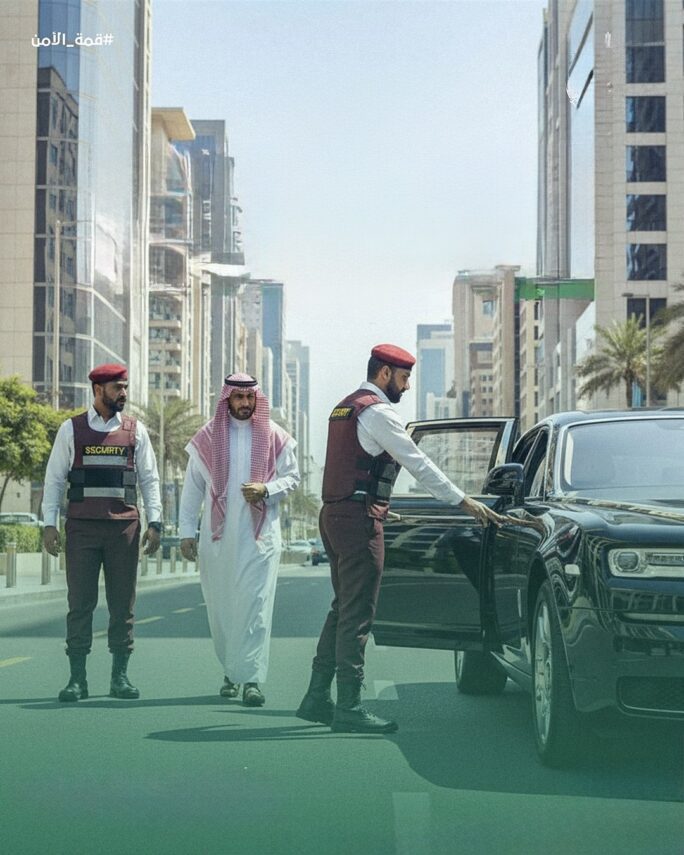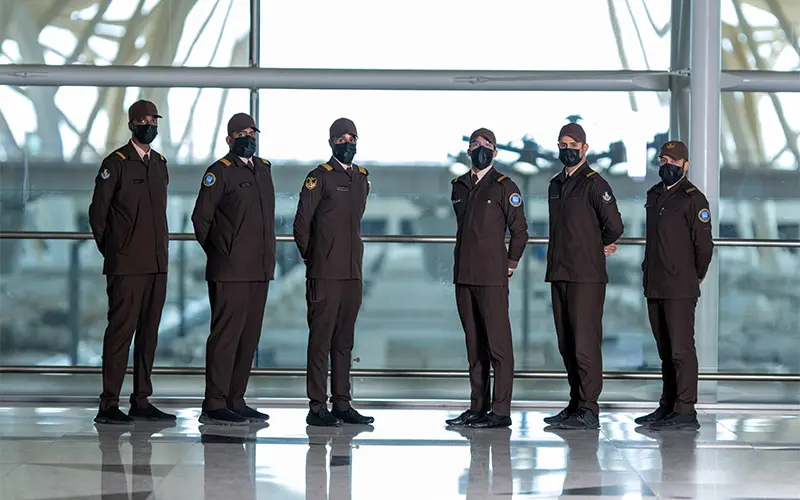
You notice a security guard’s uniform before you notice almost anything else about them.
That is not an accident. The uniform is designed to be seen, recognized, and understood instantly. But if you think the uniform is just about appearance, you are missing most of what it actually does.
In Saudi Arabia’s commercial buildings, residential compounds, industrial facilities, and public venues, a security guard’s uniform is a working tool. It supports identification, authority, deterrence, and professionalism simultaneously.
This article breaks down exactly why security guards wear uniforms, what each element contributes, and why uniform standards matter when choosing a security provider.
Key Takeaways
Security guards in Saudi Arabia wear uniforms for instant identification, deterrence through visible presence, authority without confrontation and professionalism. Article 8 of the Private Civil Security Guarding Law requires guards to wear the uniform set by the entity that employs them, and the Ministry of Human Resources and Social Development guard sector requirements oblige the employer to provide it.
- A security guard uniform lets visitors recognise security instantly and deters theft, vandalism and unauthorised access through visible presence.
- Article 8 of the Private Civil Security Guarding Law issued by Royal Decree M/24 states that guards must wear the uniform set by the entity that employs them, as the executive regulations provide.
- The guard sector work environment requirements issued by the Ministry of Human Resources and Social Development in October 2022 oblige the employer to provide uniforms and prohibit posting a guard in the open during the midday work ban hours without a sunshade.
- The identity of a guard uniform stays fixed in colour, logo and ID card, while the layers and kit change with the weather and the post, such as a reflective vest on night patrols.
- The female security guard uniform is modest, loose and long, usually a long coat or practical abaya in the company colours with a head covering, with the logo and ID card visible.
What a Security Guard Uniform Typically Includes
A professional security guard uniform in Saudi Arabia generally consists of:
- A structured shirt or jacket bearing the company logo and role identification
- Trousers made from durable, practical fabric
- A visible badge or ID bearing the guard’s name, role, and company details
- Footwear suitable for long shifts and varied terrain
- A utility belt carrying radio, flashlight, and access tools
- High-visibility or reflective elements for outdoor and low-light duties
- Sunglasses for outdoor assignments in Saudi Arabia’s climate
Each element serves a specific function. None of it is decorative.
Core Reasons Why Security Guards Wear Uniforms
Instant Identification in Any Environment
The most direct purpose of a uniform is identification. In a busy shopping mall, a large compound, a hospital, or a corporate tower, people need to know immediately who to approach in an emergency, who has authority to direct them, and who to contact if something feels wrong.
A clearly uniformed guard removes all ambiguity. In a moment of stress, a visitor does not need to ask who the security professional is. The uniform answers that question instantly.
This is especially important in Saudi Arabia’s diverse commercial environments, where a single site may host employees, contractors, and visitors from many different countries and backgrounds.
Deterrence Before Any Action Is Taken
A visible, clearly marked security guard makes potential wrongdoers reconsider their intentions before any confrontation takes place.
People are less likely to attempt theft, vandalism, or unauthorized access when security is visibly present and clearly organized. This deterrent effect operates entirely on visibility. The uniform does the work before the guard needs to say or do anything.
Preventive security is always more effective than reactive security. The uniform is one of the most consistent tools for achieving prevention.
Authority Without Confrontation
When a uniformed guard directs someone to show identification, redirects access, or manages a minor dispute, the uniform itself reinforces their right to act. People respond more cooperatively to clearly identified authority than to someone asserting control without any visible credentials.
This reduction in friction is practically valuable. It allows guards to manage situations calmly and professionally without escalating to confrontation. In Saudi Arabia’s culturally diverse commercial settings, this non-verbal communication of authority is particularly important.
Professionalism Builds Trust
A clean, well-maintained uniform signals that security is being taken seriously. It tells clients, employees, and the public that the organization has invested in professional standards.
This matters in corporate offices, premium residential compounds, healthcare facilities, and anywhere else where the perceived quality of security reflects directly on the organization responsible for it.
The uniform also creates accountability. It shows that the guard is part of an identifiable, structured team. That visibility encourages professional behavior and gives clients a reference point if standards are not met.
Practical Design for Real Working Conditions
Security uniforms are built for the demands of the job, not just for appearance. Durable materials handle long shifts, physical movement, and varying weather conditions. High-visibility elements such as reflective strips ensure guards are easily seen during night patrols or in low-light areas.
Utility belts allow guards to carry radios, flashlights, and access control tools within immediate reach. Footwear is designed for extended hours on foot across varied surfaces.
In Saudi Arabia, where outdoor security assignments involve intense heat for much of the year, the practical design of uniforms also addresses thermal management. Appropriate fabric weight, breathability, and sun protection are considerations for guards working outdoor posts across Riyadh, Jeddah, Dammam, and the Eastern Province.
Team Consistency Strengthens Security Presence
When every guard at a site or across a security company’s team wears the same uniform, it creates a cohesive and organized impression. Clients and the public see a team, not a collection of individuals.
This consistency reinforces the deterrent effect. A coordinated, uniform security team signals that operations are structured, supervised, and professional. Inconsistency in uniform presentation, by contrast, is often a visible indicator of broader quality issues with the provider.
Security Guard Uniforms in Saudi Arabia: Local Context
Saudi Arabia’s commercial and regulatory environment shapes uniform standards in specific ways.
MOI-licensed security companies are expected to maintain defined standards for guard presentation and identification. A properly uniformed guard is part of what it means to operate a compliant, professional security service under the Ministry of Interior’s framework.
The Kingdom’s climate also influences uniform design. Outdoor guards working in summer temperatures that regularly exceed 45 degrees Celsius require uniforms that support sustained physical activity without overheating. Professional providers account for this in their uniform specifications.
Saudi Arabia’s growing commercial development under Vision 2030 has raised expectations for security presentation. In high-profile environments such as luxury hotels, premium retail developments, and major corporate campuses, the appearance standard for security personnel is as important as their functional capability.
What Good Uniform Standards Look Like
Cleanliness is non-negotiable. A dirty or poorly maintained uniform undermines every benefit the uniform is meant to provide. Professional security companies set and enforce presentation standards as part of their daily deployment checks.
Badge visibility matters. A badge tucked under a jacket or facing the wrong way defeats its purpose. Guards should wear visible identification at all times during deployment.
Uniforms should be consistent across a team. Mixed or mismatched uniforms signal a disorganized operation. When assessing a security provider, look at whether their guards present consistently.
Sunglasses have a defined role outdoors but should be removed indoors. Professional guards are trained on when sunglasses are appropriate. Wearing them indoors or during direct personal conversations reduces approachability and professionalism.
Uniform quality reflects company investment. A provider who cuts corners on uniform standards is likely cutting corners elsewhere. Presentation is the visible part of a wider set of operational standards.
Common Mistakes People Make With Security Guard Uniforms
Accepting Inconsistent Presentation From a Provider
If guards from the same company arrive at your site with different uniform standards, missing badges, or poorly maintained attire, that inconsistency is a performance signal, not just an appearance issue. Raise it immediately.
Confusing a Smart Uniform With Effective Security
A well-dressed guard is not automatically a well-trained guard. Uniform standards matter, but they should accompany proper training, clear post orders, supervision, and documentation. Appearance is one component of professional security, not a substitute for the others.
Not Specifying Uniform Requirements in Your Contract
When engaging a security company in Saudi Arabia, your contract should specify uniform standards, badge requirements, and presentation expectations. If it does not, you have no basis for holding the provider accountable.
Allowing Guards to Modify Their Uniform
Unauthorized modifications to uniforms, removing badges, wearing personal items over the issued uniform, or using non-standard equipment breaks the consistency and identification function the uniform provides. This should be addressed as a conduct issue.
When Should You Contact a Professional Security Company?
If any of the following apply, it is time to review your current security arrangements with an MOI-licensed provider:
- Your current guards present inconsistently or without proper identification
- You are setting up security for a new site and need to define standards
- Your existing provider cannot demonstrate MOI licensing or uniform compliance
- You have received complaints about the appearance or conduct of on-site security
- You are preparing a site for a client, government inspection, or high-profile event
A professional provider will set and maintain clear uniform standards as part of a broader service quality framework.
What Saudi Regulations Say About the Guard Uniform
Article 8 of the Private Civil Security Guarding Law, issued by Royal Decree M/24 dated 8/7/1426H, states that guards must wear the uniform set by the entity that employs them, as the executive regulations provide. In other words, wearing the uniform is a legal duty for the guard, while its design and details are set by the licensed company within the executive regulations.
The Requirements for Work Environment for the Security Guards Sector, issued by the Ministry of Human Resources and Social Development in October 2022, require the employer to provide guards with uniforms and to follow occupational safety guidance on direct sun exposure and heat stress. They also prohibit posting a guard during the midday outdoor work ban hours without a sunshade. In 2026 the ban ran from 15 June to 15 September, between 12 noon and 3 pm.
What About the ID Card
The law text does not detail the ID card or badge. In usual practice, the licensed company issues each guard a card with name, photo and company name, and many sites add their own access pass. The fee schedule approved in 1444H also lists an annual licence for the individual guard. The client is entitled to ask that the card stays visible for the whole shift.
Uniform by Season and Post Conditions
One uniform does not suit every post all year. The rule is that identity stays fixed, meaning the colour, logo and ID card, while the layers and kit change with the weather and the nature of the post.
Summer and Outdoor Posts
For gates, car parks and perimeter fences, light breathable fabric in light colours works best, with a cap carrying the company logo and a spare shirt in humid coastal cities such as Jeddah, Dammam and Jubail. A cooled guard room or sunshade and drinking water nearby complete the picture, because the uniform alone does not prevent heat stress.
Winter in the North and the Highlands
Winter nights in Tabuk, Hail, Al Jawf, the Northern Borders and Abha are cold, so night posts need a jacket in the same uniform colour with the logo on it, so that guards never cover their identity with personal clothing.
Night Work, Construction and Industrial Sites
On night patrols and near vehicle traffic, a reflective vest goes over the uniform. On construction sites, the guard follows the site safety rules for helmet, safety boots and reflective vest. In factories and oil, gas and petrochemical plants, the guard wears the protective equipment required by the site work permit rules, which may include flame resistant clothing.
Uniform by Site Type, Including Female Guards
- Corporate offices and hotels: a formal look such as a tailored jacket, trousers and polished shoes, because the reception guard is the first person a visitor meets.
- Residential compounds: a smart practical uniform such as a logo polo shirt that suits long patrols inside the compound.
- Factories and warehouses: durable workwear or coveralls with the protective equipment the site requires.
- Events and exhibitions: high visibility tabards printed with Security in Arabic and English, so crowds can find a guard quickly.
- Hospitals and universities: a calm, clean uniform that suits patients and students while staying easy to recognise.
The Female Guard Uniform
Female security guards work at women entrances and sections, events, universities, hospitals and malls. Their uniform is modest, loose and long, usually a long coat or practical abaya in the company colours with a head covering, the logo and ID card visible, and flat closed shoes for long hours standing. What matters is that every female guard on the site wears the same uniform so that women visitors recognise them at once.
Who Provides the Uniform and What to Put in the Contract
The guarding company is the employer, so it provides, specifies and replaces the uniform for its guards. The client can set out in the contract what the site needs. The most useful clauses are:
- The uniform style for each post, formal at reception and practical at gates and fences.
- The number of sets per guard, how often they are replaced, and the winter and summer layers.
- The protective equipment the site requires, such as helmet, safety boots and reflective vest.
- The female guard uniform where the site has women posts.
- Rules for keeping the ID card visible for the whole shift.
- An appearance check by the supervisor at the start of every shift, recorded, with the agreed action when standards are missed.
At Qimah Security Guards, the uniform and protective equipment for every post are written into the guarding plan we prepare after the site security survey, so the client knows in advance how each guard will look on site.
Frequently Asked Questions
Why do security guards in Saudi Arabia wear uniforms instead of plain clothes? Uniforms serve identification, deterrence, and authority functions that plain clothes cannot. They allow people to immediately recognize security personnel, deter potential wrongdoers through visible presence, and communicate defined authority without verbal assertion.
Are security guard uniforms required by law in Saudi Arabia? Yes. Article 8 of the Private Civil Security Guarding Law requires guards to wear the uniform set by their employer, as the executive regulations provide, and the HRSD guard sector requirements oblige the employer to provide it.
What should a security guard’s badge show? A professional badge should display the guard’s name or ID number, their role title, and the company they represent. It should be clearly distinct from police or law enforcement insignia.
Why do security guards sometimes wear high-visibility vests? High-visibility elements are used for outdoor, mobile patrol, and event security roles where guards need to be easily seen by drivers, crowds, or in low-light conditions. They are a practical safety and identification feature.
Does a well-presented security guard actually deter crime? Yes. Research and professional security practice consistently show that a clearly identifiable, well-presented security presence reduces the likelihood of theft, vandalism, and unauthorized access. Potential wrongdoers assess visible risk before acting.
What is the difference between a security guard badge and a police badge? Security guard badges are intentionally designed to be distinct from police or military insignia. They identify the guard as a private security professional with defined, site-specific authority, not as a law enforcement officer.
How should I assess a security company’s uniform standards before hiring them? Ask to see images of their deployed guards, request their uniform policy documentation, and check whether their contract specifies presentation standards. You can also ask for references from existing clients who can speak to the company’s day-to-day presentation consistency.
Final Takeaways
Security guard uniforms in Saudi Arabia are not a formality. They are a functional tool that delivers identification, deterrence, authority, professionalism, and practical performance support all at once.
For businesses hiring security services, uniform standards are a visible indicator of broader operational quality. A provider that maintains consistent, professional presentation is more likely to maintain consistent, professional security performance.
When assessing any security company, look at how their guards present. It tells you more about the provider than any sales pitch will.
If you are reviewing your current security arrangements or setting up a new site, contact an MOI-licensed security company for a professional assessment.