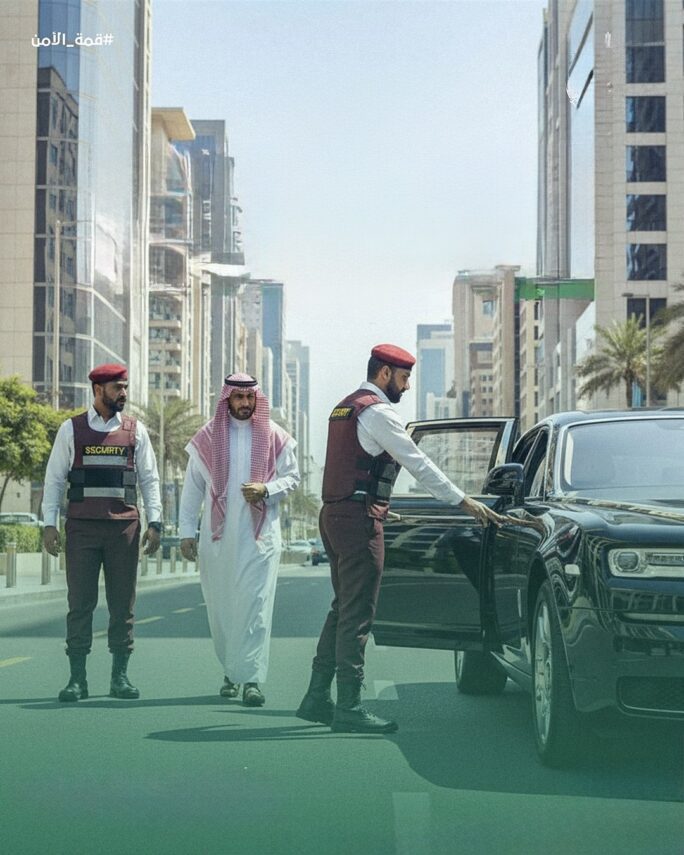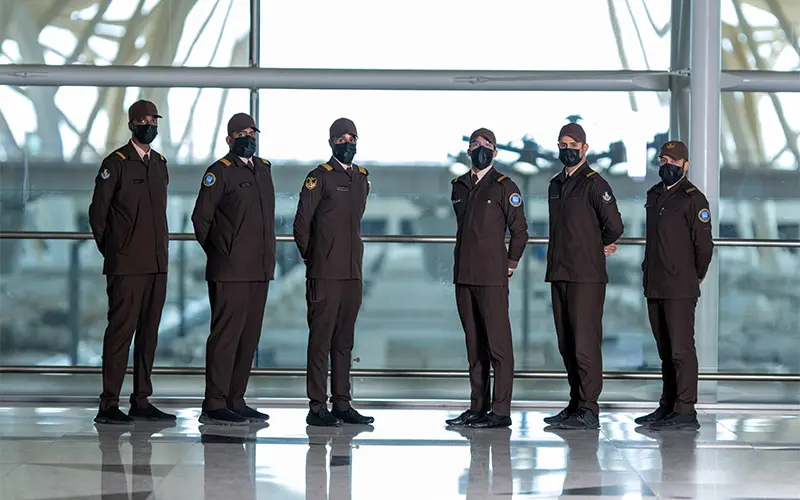
It is one of the questions that comes up consistently when people think about professional security: are the guards armed? The assumption tends to lean toward yes — that armed security is the serious option and unarmed security is somehow less legitimate. Both assumptions are wrong, and understanding why leads to better security decisions.
Key Takeaways
- Private civil security guards in Saudi Arabia are unarmed by default, because the law defines guarding as a human security service provided by licensed companies for a fee.
- The Private Civil Security Guarding Law, issued by Royal Decree M/24 in 1426H, contains no provision that allows a security guard to carry a weapon.
- The Saudi Weapons and Ammunition Law prohibits carrying or possessing a weapon without a licence, so a guarding company licence alone is not a permit to arm guards.
- Firearms in Saudi private security are tied to specific licensed activities, the clearest being the transport of cash and precious metals, governed by a separate law issued by Royal Decree M/81 in 1428H.
- Qimah Security Guards provides licensed unarmed guards, the right fit for most offices, residential compounds, malls and warehouses in Saudi Arabia.
The Short Answer: Most Commercial Security Guards Are Not Armed
Standard private security guards deployed across Saudi Arabia’s commercial, residential, and industrial environments do not carry firearms. The vast majority of security work in the Kingdom — protecting office buildings, shopping centers, residential compounds, warehouses, hospitals, hotels, and construction sites — is performed by unarmed professionals.
This is not a resource constraint or a regulatory accident. It is the appropriate model for the environments and risks involved.
Deterrence, access control, patrolling, emergency response, and professional presence do not require weapons. A trained, properly supervised, professionally presented unarmed security team is the right solution for most commercial deployments and is entirely sufficient for the risk profiles those deployments face.
When Armed Security Is Used
Armed private security exists in Saudi Arabia and is deployed in specific, defined contexts. The contexts where it is appropriate share a common characteristic: the risk assessment has identified a specific, credible threat that justifies armed response capability as part of the protective arrangement.
Cash-in-transit operations are the clearest commercial example. Transporting significant cash or high-value assets between locations involves a calculable risk profile that armed escorts are specifically designed to address. The combination of the asset value, the mobile exposure, and the specific threat history in this category makes armed deployment appropriate.
Industrial and petroleum facilities. At industrial and petroleum facilities, private guarding companies are licensed, inspected and audited by HCIS, and their unarmed guards work within the protection arrangements set by the facility and the authorities.
High-value asset protection in specific assessed threat environments occasionally warrants armed capability where the nature of what is being protected and the realistic threat level combine to justify it.
Personal protection. Personal protection of individuals is a separate specialism that sits outside the private civil guarding service provided by Qimah Security Guards, whose guards are unarmed.
The common thread is assessment-based justification. Armed security in Saudi Arabia is a targeted tool deployed where the risk genuinely warrants it — not a general upgrade available to anyone who wants to project seriousness.
The Regulatory Framework for Armed Security
Armed private security in Saudi Arabia is governed by specific additional requirements beyond the standard MOI framework.
In Saudi Arabia, the clearest legal route for armed private security is cash transport, where the Cash Transport Law issued by Royal Decree M/81 dated 18/10/1428H requires vehicle crews to be provided with the necessary weapons. The Private Civil Security Guarding Law itself contains no provision on weapons. The Weapons and Ammunition Law prohibits carrying a weapon without a licence, so a guarding licence alone is not a permit to arm unarmed guards.
Cash transport crews must also meet their own conditions under the Cash Transport Law, including Saudi nationality and an age between 20 and 50. Which weapons are issued and how they may be used is set by the Minister of Interior under the Weapons and Ammunition Law, not by the company alone.
Qimah Security Guards provides unarmed licensed guards only and does not offer cash transport. Guards do not carry personal weapons on commercial security assignments.
Why Unarmed Security Is Entirely Effective for Most Environments
The presence or absence of a firearm does not determine whether a security deployment is effective for a given environment. The quality of the personnel, the depth of their training, the supervision they operate under, and the quality of their post orders determine that.
A professional unarmed security team, properly trained and supervised, delivers genuine deterrence through visible professional presence. Potential wrongdoers make rapid threat assessments — the presence of an organized, professional security operation is itself a deterrent regardless of whether those guards carry firearms.
For the environments most businesses in Saudi Arabia operate in, the realistic threats — unauthorized access, opportunistic theft, disruptive behavior — are effectively managed by professional unarmed personnel. Armed guards do not improve the deterrent effect for these threats and add cost, regulatory complexity, and operational requirements that are only justified by a correspondingly elevated risk profile.
The Risk Assessment Is the Deciding Factor
The question of whether your security deployment should include armed capability should never be decided by preference, convention, or a desire to appear serious. It should be decided by a professional risk assessment that examines the specific, realistic threats your premises or operation faces and determines whether those threats require armed response capability in their mitigation.
For most commercial environments in Saudi Arabia, that assessment will conclude that professional unarmed security is appropriate and sufficient. Where an assessment points to cash or valuables in transit, that work belongs to a company licensed under the Cash Transport Law, while the site itself can still be protected by licensed unarmed guards.
What Does Saudi Law Say About Security Guards Carrying Weapons?
The short answer is that a civil security guard in Saudi Arabia does not carry a weapon as part of the job. The Private Civil Security Guarding Law, issued by Royal Decree M/24 dated 8/7/1426H, defines guarding as a human security service that licensed establishments and companies provide to clients for a fee. The licence is issued by the Minister of Interior or his delegate, and none of its articles mention weapons.
Weapons fall under the Weapons and Ammunition Law, issued by Royal Decree M/45 dated 25/7/1426H, which prohibits carrying or possessing a weapon without a licence. A guarding company licence is therefore not enough to arm its guards, because firearms in private security are tied to specific licensed activities.
Cash Transport Is the Clearest Example
The Law on the Transport of Cash, Precious Metals and Valuable Documents, issued by Royal Decree M/81 dated 18/10/1428H, regulates this activity under a separate three year licence issued by the Director of Public Security. Article 11 requires vehicle crews to be provided with the necessary weapons, as the Minister of Interior specifies under the Weapons and Ammunition Law, and the implementing regulation states that two of the three crew members, the escort and the guard, are armed.
Conditions the law sets for this activity include:
- Saudi nationality for every vehicle crew member.
- A crew member age between 20 and 50.
- A separate licence for each vehicle, issued by the Public Security directorate.
Unarmed Guards or Armed Crews: What Is the Difference and When Does Each Fit?
The difference is not how serious the security is but what the job is. An unarmed guard protects a fixed site with its people and assets, while an armed crew escorts portable value on the road.
Licensed Unarmed Security Guards
- Legal basis: the Private Civil Security Guarding Law and the guarding company licence.
- Typical use: offices, towers, residential compounds, malls, hospitals, hotels and warehouses.
- Core tasks: access control, patrols, camera monitoring in the site control room and incident reporting.
- Tools: uniform, ID card, radio, shift log and written post orders.
Armed Cash Transport Crews
- Legal basis: the Cash Transport Law, the Weapons and Ammunition Law and a separate Public Security licence.
- Typical use: moving cash, precious metals and valuable documents between branches and organisations.
- Core tasks: escorting and protecting the consignment during transport and handover.
- Tools: a licensed vehicle and weapons as the Minister of Interior specifies under the Weapons and Ammunition Law.
If your business needs cash moved, that service belongs to a company licensed under the Cash Transport Law, while guarding the site itself remains a job for licensed unarmed guards.
Why Do Unarmed Guards Fit Most Commercial Sites in Saudi Arabia?
Because the everyday risks at commercial sites are unauthorised entry, opportunistic theft, disputes and emergencies, and all of them are handled by disciplined presence, clear procedures and fast escalation to the police or to Civil Defense on 998, not by weapons.
When the Ministry of Interior amended Article 2 of the guarding executive regulations in 1446H, the sites required to contract civil guarding included hotels, banks, hospitals and gold and jewellery shops around the clock, as well as markets with 30 shops or more and closed compounds with more than 10 villas or 50 units.
What a Weapon Does Not Add at a Commercial Site
- It does not improve access control, which depends on training, procedure and how guards deal with visitors.
- It does not deter more in an office or mall than an organised, visible presence already does.
- It does not make up for weak supervision, since an undisciplined guard is a liability whatever the equipment.
- It adds heavier legal and insurance burdens that the risk level at most sites does not justify.
Qimah Security Guards works under an HCIS Category One guarding licence that allows deployments of up to 1,000 guards, and provides unarmed guarding that covers gate control, patrols and field supervision. Every contract starts with a site security survey that sets the posts, patrol routes and shift pattern.
Frequently Asked Questions
Why do most commercial premises in Saudi Arabia use unarmed security guards?
Because the risk profiles of most commercial environments — unauthorized access, opportunistic theft, disruptive behavior — are effectively addressed by professional unarmed personnel. The deterrent value of a well-trained, professionally supervised security team does not depend on whether guards carry firearms.
Is a company that provides armed security automatically better than one that provides unarmed security?
No. The quality of a security company is determined by its training standards, supervision structure, operational discipline, and consistency of performance — not by whether it offers armed services. Armed capability is a specific tool for specific risk environments, not a general quality indicator.
How do I know if my business needs armed security in Saudi Arabia?
A professional security risk assessment will answer this question for your specific situation. If the assessment identifies a realistic, specific threat profile that requires armed response capability, your security company will recommend it. For the majority of commercial premises, the assessment will support a professional unarmed deployment.
Can any MOI-licensed security company provide armed guards?
No. A guarding licence is not a weapons permit, and armed roles such as cash transport fall under the Cash Transport Law and the Weapons and Ammunition Law, unlike the work of unarmed guards. Always verify that a company holds the appropriate authorization before engaging them for armed deployment.
Are armed security guards more expensive than unarmed?
Yes. Armed security carries additional licensing, training, equipment, insurance, and operational compliance costs. These are reflected in the service price. For environments where armed capability is genuinely warranted, this cost is justified. For environments where it is not, it represents additional cost for no additional security value.
Final Takeaways
Most security guards in Saudi Arabia do not carry firearms, and for most businesses, that is the right answer. Armed security is a specialized category deployed based on specific risk assessment, not as a default or a signal of seriousness. A professional unarmed deployment from a well-managed MOI-licensed company delivers effective security for most commercial environments.
If you believe your premises or operation may require armed security, request a professional risk assessment before making any decision. The assessment outcome, not convention or preference, should drive the choice.