In Saudi Arabia, CCTV does not replace security guards and guards do not replace CCTV. Cameras detect and record around the clock but cannot act, while guards judge, intervene and control entry but cannot see everything. For most sites the best answer is a guard watching the screens, a patrol verifying every alert, and compliance with Saudi camera law.
Key Takeaways
- CCTV is a tool for detection and evidence, while a security guard is a tool for judgment and response.
- A camera system that nobody watches only records an incident and does nothing to prevent or stop it while it happens.
- The most effective model for most Saudi sites is a security guard watching the screens in the control room and a patrol that verifies every alert on the ground.
- The Saudi Security Surveillance Cameras Law, issued by Royal Decree No. M/34 dated 7/3/1444H, requires wide categories of facilities to install cameras and bans them in specific places.
- Qimah Security Guards does not install cameras, it provides trained guards to run the client control room.
Which is better, CCTV or security guards?
There is no absolute winner, because the answer depends on the problem you need to solve. If you need evidence after an incident, cameras are stronger. If you need to prevent or stop an incident, nothing replaces a guard on site, so the real question is the right mix of both.
A security surveillance camera system is a set of fixed or movable cameras and recorders that watch a defined area and store the footage for later review. A security guard is a licensed, trained person present on site to observe, control entry and act when something requires action. The core difference is that a camera sees but cannot act, while a guard can act but only sees what is in front of the guard.
What can CCTV and guards each do, and where are their limits?
In short, cameras win on reach and records, and guards win on decisions and intervention. Here they are on the same attributes.
CCTV cameras
- Coverage: watches many areas at the same time, day and night, without fatigue.
- Response: cannot move and always needs a person to act on what it detects.
- Deterrence: discourages the opportunist who fears being identified, with less effect on someone who planned ahead.
- Entry control: cannot question a visitor, match an ID or stop a person from entering.
- Evidence: provides a dated visual record for investigations and insurance claims.
- Weak point: blind spots, faults, power cuts and covered lenses.
Security guards
- Coverage: sees only the immediate area and covers more ground through patrols on a set schedule.
- Response: moves at once, checks, reports, guides evacuation and calls Civil Defense on 998.
- Deterrence: a visible uniformed presence that will question a person on the spot.
- Entry control: checks IDs, logs visitors and enforces the entry and exit rules.
- Evidence: writes incident reports and patrol logs, which depend on the accuracy of observation.
- Weak point: attention can drop during long shifts when field supervision is missing.
Do I need security guards if I already have CCTV?
For most sites the answer is yes, because cameras on their own tell you what happened after it happened. A guard becomes clearly necessary in these cases:
- When the site receives visitors, contractors or trucks that must be checked at the gate.
- When goods or equipment are valuable and easy to carry away, as in warehouses and construction sites.
- When someone must raise the alarm and guide evacuation before Civil Defense arrives.
- When the site needs a visible security presence that reassures customers and staff, as in malls and residential compounds.
On the other hand, a guard without cameras works with one eye. One guard cannot cover a large warehouse in Riyadh or Dammam, and cameras extend that view to the back fences and loading yards.
How do the costs of CCTV and security guards compare?
Cameras are a large setup cost followed by lower running costs, while guards are a low setup cost followed by a steady monthly cost. A fair comparison looks at the losses each one prevents.
What goes into the cost of cameras
- Cameras, recorders, storage media, cabling and installation.
- Routine maintenance, fault repair and fault reporting, as the executive regulations require.
- The cost of someone to watch the screens, which many owners forget.
What goes into the cost of guards
- The number of guard posts and the hours each post is covered, since a round the clock post needs more than one guard because of shift rotation.
- Field supervision, patrols and reporting.
- Sector requirements, such as sites that fall under HCIS.
The practical rule: cameras for wide, quiet areas, and guards where the site needs a human decision.
How does the combined model of guards and cameras work?
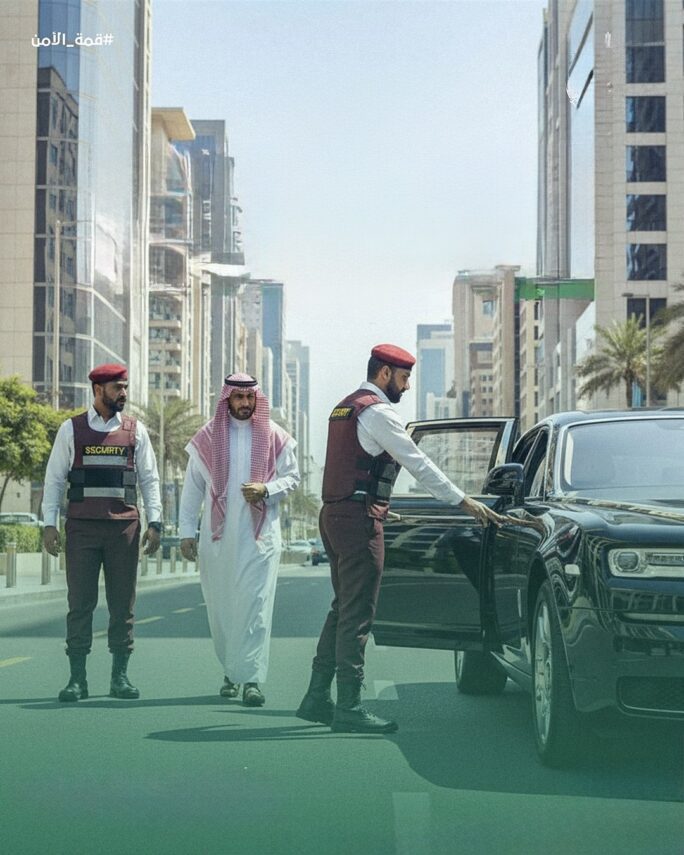
The combined model works when a trained guard watches the screens, sends the nearest guard or patrol to check any unusual movement, and records the outcome, while static guards control the gates and cameras cover fences, car parks and loading yards.
Qimah Security Guards, a licensed private security company holding an HCIS Category One guarding licence, provides the human part of this model: trained guards who run the control room inside your facility, and patrols that verify alerts on the ground. We do not install cameras or run a remote monitoring centre, we work on the system you already have.
What does Saudi law say about security surveillance cameras?
Saudi Arabia regulates cameras through a dedicated law, the Security Surveillance Cameras Law, issued by Royal Decree No. M/34 dated 7/3/1444H based on Council of Ministers Decision No. 164 dated 1/3/1444H. The Ministry of Interior then approved its executive regulations, the security requirements document and the site sensitivity classification by Ministerial Decision No. 22688 dated 3/11/1444H, published in the Umm Al Qura official gazette on 20/11/1444H.
Who must install cameras?
- Government bodies, oil and petrochemical sites, and power and desalination plants.
- Malls, banks, health facilities, schools and multi unit residential buildings.
- Commercial warehouses, fuel stations and event venues, plus any category the Ministry adds.
Where are cameras banned?
The law bans cameras in medical examination rooms, inpatient and physiotherapy rooms, changing rooms, toilets, and women salons and clubs. The regulations also ban audio recording without approval.
How long must footage be kept, and when can it be released?
The law itself does not set a fixed number of days. Footage is kept for the period set in the security requirements document, and after an incident it must be kept unaltered until the investigation ends, whichever is longer. Footage may be transferred or published only with approval from the Ministry of Interior or the State Security Presidency, a court order or a request from the competent investigating authority.
According to the Ministry of Interior, the fine for transferring or publishing footage in breach of the law is 20,000 riyals, the fine for installing cameras in banned places is 10,000 riyals, and the fine for not keeping footage for the required period is 5,000 riyals. The ministerial decision gave high sensitivity facilities 360 days from publication of the regulations to install cameras, and medium and low sensitivity facilities 540 days.
How do you decide the right mix for your site?
Start with the risk, not the tool, then choose for each risk the tool that prevents or detects it.
- Unauthorised entry? Start with a guard at the gate and proper access control.
- Large area at night? Combine cameras with a mobile patrol that verifies alerts.
- Is nobody watching your control room? Add a trained guard before buying more cameras.
In the industrial cities of Jubail and Dammam or the compounds of Riyadh and Jeddah, a site security survey often shows that the gap is nobody watching the cameras, not too few cameras. Qimah Security Guards runs this survey as part of guarding plans in more than 25 Saudi cities.
Frequently Asked Questions About CCTV and Security Guards
Can CCTV replace security guards?
In most sites CCTV cannot replace a guard, because cameras only detect and record and cannot stop a person from entering, intervene during an incident or guide an evacuation. Warehouses, compounds and construction sites in Saudi Arabia need a guard watching the screens and a patrol checking alerts.
Which deters theft more, cameras or guards?
A visible guard is the stronger deterrent in the moment, because a person knows they will be noticed and questioned at once. A camera deters people who fear being identified later, but its effect is weaker on someone who planned ahead or covered their face, so the best setup combines both.
Are surveillance cameras mandatory in Saudi Arabia?
Yes, for many categories of facility under the Security Surveillance Cameras Law, including government bodies, malls, banks, health facilities, schools, multi unit residential buildings, fuel stations and commercial warehouses. Cameras that individuals install inside their own private homes are excluded, and the Ministry of Interior sets the compliance dates for each category.
How long must CCTV footage be kept in Saudi Arabia?
Footage must be kept for the period set in the security requirements document approved by the Ministry of Interior, and after an incident it must be kept unaltered until the investigation ends, whichever is longer. The fine for not keeping footage for the required period is 5,000 riyals.
Can I post CCTV footage on social media?
No. Security camera footage may be transferred or published only with approval from the Ministry of Interior or the State Security Presidency, a court order or a request from the competent investigating authority. The fine for unlawful publishing is 20,000 riyals, so hand the clip to the authorities instead of posting it, even if it shows a thief.
Related Reading
- CCTV monitoring by trained security guards
- Mobile security patrol services
- Security risk assessment and site survey
- Layers of security in business
- Access control and gate management
- How much security your business actually needs
Are your cameras running with nobody watching?
Request a site visit from Qimah Security Guards to assess your site and define the guards, posts and patrols that complete your camera system. Contact us by phone or WhatsApp on +966 53 426 1698 or request a quote.